
What this tool adds
What this tool adds to your bench
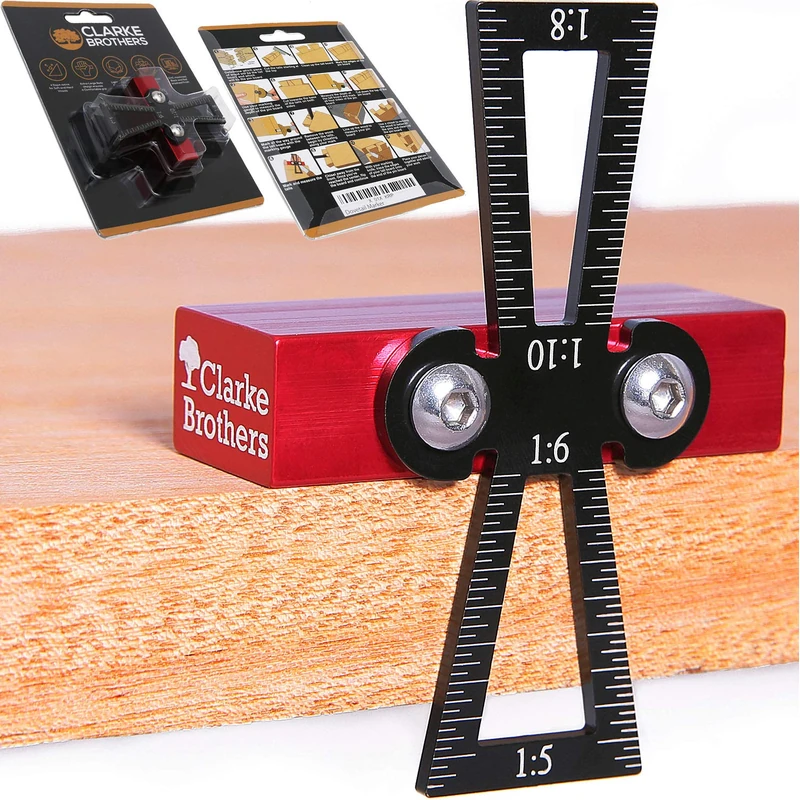
Choose this marker when you want several dovetail slopes available in one layout tool. Its marked references are 1:5, 1:6, 1:8 and 1:10. Switching the reference changes the slope of the line; it does not automatically choose tail spacing, joint width or the number of tails for your board.
The selected illustrations place the 1:5 and 1:6 references together and the 1:8 and 1:10 references on the other end. The source associates the first pair with softwoods and the second with hardwoods. Use those as the stated layout options, rather than a promise that one slope guarantees a stronger joint.
The tool uses aluminum parts with a black and red anodized finish, with imperial graduations on both sides. Its crossbar and shaped reference pieces form the marking tool. Choose it for the slope selection and registration that fit your layout method, not for an unverified machining tolerance.
Compare Rockler’s fixed 1:6 saddle square when corner-straddling registration is the priority. A marking knife remains a separate way to score the chosen line. This tool marks references; it is not established as a clamp, a saw fence or an automatic dovetail-spacing jig.
Choose for your actual work
- Choose for slope variety or compare a fixed saddle reference for corner registration.
- Plan tail spacing separately from the marked slope.
Fit checks & limits
- Treat the four slopes as layout references, not confirmed saw-guiding surfaces.
- Check the intended ratio and registration on your workpiece. No numerical machining tolerance is specified for a tolerance-critical layout.
Questions before you choose
Does choosing a slope set the dovetail spacing?
The slopes guide the angle of the lines. You still plan the number, width and spacing of tails for the joint.
What is the advantage over a fixed1:6 marker?
It provides four marked slopes in one tool. Compare the fixed Rockler saddle if its corner registration matters more than having several slope choices.
Can I use it as a saw guide?
The selected evidence establishes a marking tool. A cutting-guide, clamping or saw-bearing function is not established.