
What this tool adds
What this tool adds to your bench
Choose the 813900 for a cut layout line that follows a straightedge or the boundary you are transferring. Unlike a fence gauge, this knife does not set a repeatable distance from an edge on its own. That makes it a complementary layout tool when the reference is a joint or guide rather than a preset offset.
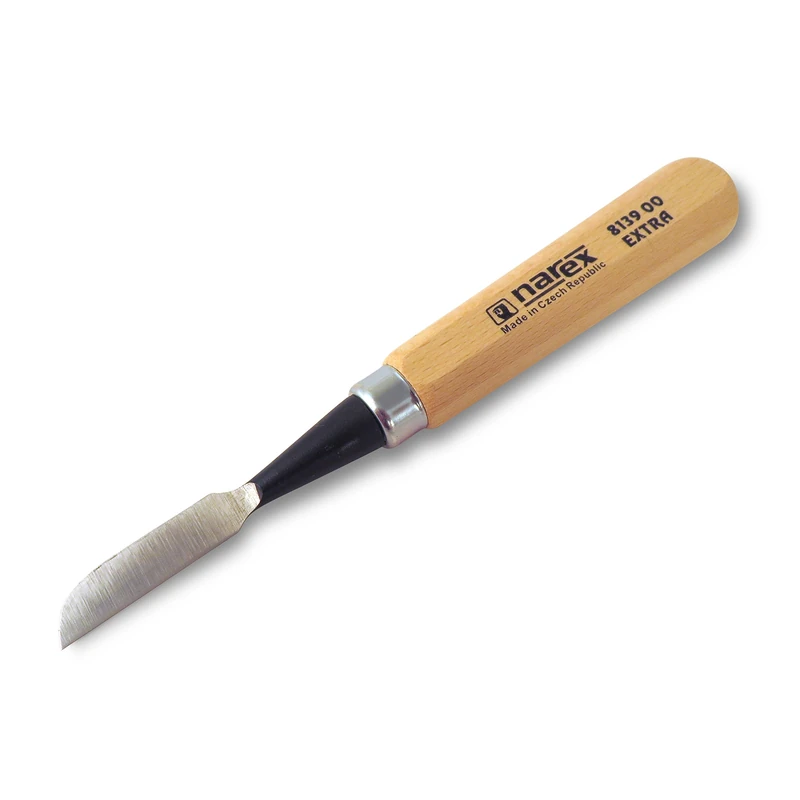
The blade is listed at 2.75 inches long, 0.380 inch wide and 0.075 inch thick. Compare the actual access around your joint with those dimensions. A thin blade is useful to evaluate for restricted layout work, but it is not a guarantee that the knife fits every narrow dovetail socket.
Narex identifies chromium-manganese steel hardened to 58 HRc. Both bevels are listed at 7 degrees each. This is a double-bevel blade: do not choose it expecting the flat reference face of a single-bevel knife.
The octagonal beech handle is listed at 4.125 inches long. Choose this knife when you need to place and guide the score yourself; compare a Kebiki for repeating an offset or a dovetail saddle square for carrying a fixed slope across a corner. Those tools provide different references rather than replacing the same function.
Choose for your actual work
- Choose a knife when the guide or joint supplies the reference.
- Compare double-bevel geometry with the reference face your technique requires.
Fit checks & limits
- No universal narrow-socket fit is established.
- The name striking knife does not establish permission to strike it with a hammer.
Questions before you choose
Will this repeat an offset from the board edge by itself?
It has no setting fence. Compare a Kebiki or wheel gauge if you need the tool to maintain a chosen distance from the edge.
Does it have a flat face like a single-bevel marking knife?
The selected source describes two bevels, each at 7 degrees. Choose it with that geometry in mind rather than expecting a single-bevel reference face.
How should I compare it for a narrow joint?
Check the listed blade width and thickness against the access in your joint. The description does not establish a universal minimum socket size.