
What this tool adds
What this tool adds to your bench
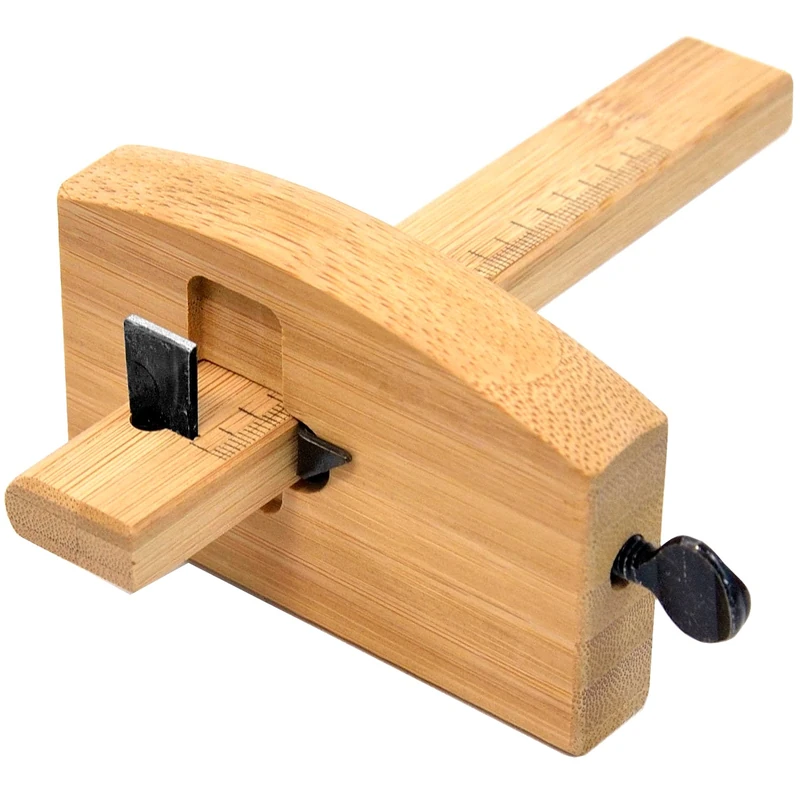
The 40947 is a single-blade Kebiki: set the distance from the board edge, lock the setting with the hand screw and guide the body along the edge. Choose it when one repeatable offset line is the layout task, rather than buying a double-blade tool only for its extra blade.
Its metric scale and listed maximum marking width of 90 mm suit users who want to work in millimeters. Compare that range with the actual distance your layout requires. It is a marking dimension, not a statement about the thickness of a board or the width of a completed mortise.
The body is natural bamboo and the cutting blade is Japanese carbon steel. The selected listing gives the tool size as 4.3 by 2.3 by 5.9 inches and the weight as approximately 3.1 ounces. The blade can retract into the body when the gauge is stored.
Compare the dual-blade Kakuri when laying out two parallel boundaries in one pass matters. The Taytools wheel gauge offers a different cutter format and fine adjustment. Choose between them by line arrangement, adjustment method and required reach, rather than expecting one gauge to cover every joinery layout.
Choose for your actual work
- Measure the required edge offset against the 90 mm marking range.
- Choose single- or double-line layout before comparing materials.
Fit checks & limits
- No blade hardness, universal replacement reference or independently measured tolerance is established.
Use & care
The cutting edge can be stored within the body when not in use.
Questions before you choose
When is the single-blade version enough?
It suits an edge-referenced layout that needs one scored line at a time. Compare the dual-blade model if two parallel boundaries in the same pass would help your workflow.
Can I use 90 mm as the maximum board thickness?
No. The listing describes a maximum marking width. It does not establish a board-thickness capacity or a 90 mm mortise spacing.
What changes if I choose a wheel gauge instead?
The Taytools alternative uses a round cutter and a fine-adjustment control. This Kebiki uses a blade and a metric setting scale; compare the contact and setting method you prefer.