
What this tool adds
What this tool adds to your bench
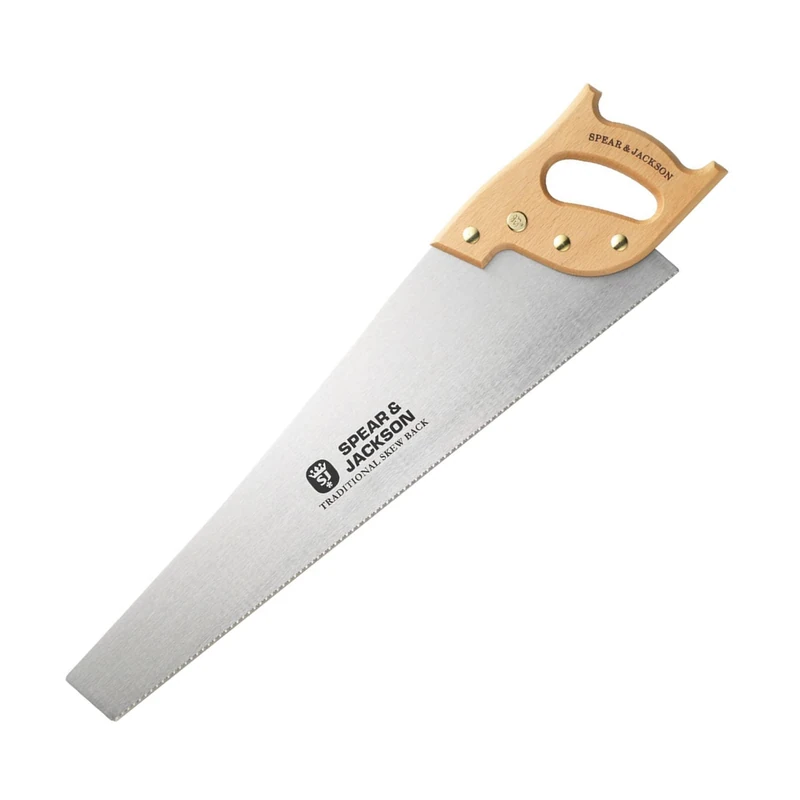
Choose the 9500R for general wood sawing when a long unbacked blade suits the work. The maker describes use both along and across the grain. That offers a different role from a short brass-backed joinery saw or a compact frame saw following a tight curve.
The blade is 559 mm long, nominally 22 inches, with 10 PPI teeth. PPI is the maker’s points-per-inch label and is kept separate from the TPI labels used on other saws. Use the stated tooth convention when comparing products rather than silently treating the two terms as the same count.
The hardened and tempered carbon-steel blade has resharpenable, cross-ground teeth. Its wooden handle is secured with rivets. Skew back describes the blade’s upper outline; it does not mean that the saw has a brass or steel stiffening spine along that edge.
Choose it when a full-length general-purpose saw and wooden full handle suit the stock and available stroke space. Compare the pistol-grip Suizan timber saw for a shorter dedicated crosscut pull-saw format, or the Crown tenon saw for a backed joinery approach. The other saws in the assortment photograph are not supplied with this single-saw offer.
Choose for your actual work
- Check room for the long blade and intended sawing stroke.
- Compare the maker’s PPI label without converting it to TPI by assumption.
Fit checks & limits
- No exact kerf, universal material capacity or numerical sharpening angle is established.
- The assortment photograph does not describe the retail contents.
Use & care
The maker identifies the teeth as resharpenable; use instructions matched to their actual geometry.
Questions before you choose
Does skew back mean a reinforced spine like a tenon saw?
It describes the shape of the upper blade outline. This selected handsaw does not have a separate stiffening back.
Can I compare its 10 PPI directly with another saw’s 10 TPI?
Keep the stated counting convention visible. The maker labels this model in points per inch; do not silently substitute a teeth-per-inch claim.
Would it serve the same work as a short frame saw?
The long handsaw is for general stock sawing. A narrow blade held in a frame provides a different approach to curves and internal shapes.