
What this tool adds
What this tool adds to your bench
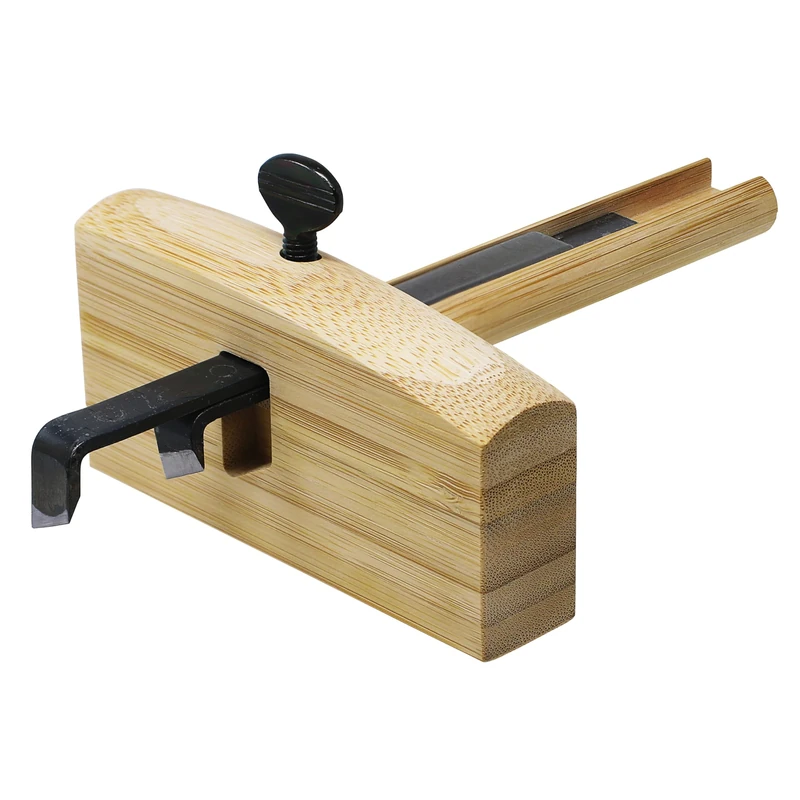
Two adjustable cutting blades are the reason to choose this Kebiki. They let you lay out two parallel boundaries in one pass for work such as mortises, tenons, grooves or rabbets. You can also use one blade when the next operation needs just a single line.
The fence registers along the board edge while the blades score the layout. The selected listing gives a maximum marking width of 90 mm, approximately 3.5 inches. It does not establish that figure as the maximum gap between the two blades, so compare a critical joint width before buying.
The body is laminated bamboo and the blades are Japanese carbon steel. The listed complete-tool dimensions are 4.8 by 3.9 by 2.8 inches, with a weight of approximately 4.9 ounces. This is one dual-blade gauge, rather than a pair of separate marking gauges.
Choose it when keeping two parallel boundaries in one layout pass is useful. Compare the single-blade 40947 for a simpler one-line task, or the iGaging mortise wheel gauge for a different cutter and adjustment system. A scored layout still needs to be followed during cutting; the gauge does not guide a saw or chisel.
Choose for your actual work
- Compare two-line workflow with the single-blade alternative.
- Confirm a critical blade separation separately from the published marking width.
Fit checks & limits
- Maximum gap between blades is not established.
- No cutting-guide function or universal blade replacement fit is established.
Questions before you choose
What practical difference do the two blades make?
They can score a pair of parallel boundaries in one pass, which is relevant to mortise, tenon and groove layout. The single-blade Kebiki marks one line at a time.
Can I still mark only one line?
The selected source describes using only one blade for a single-line layout. You are not limited to paired marks for every operation.
Is 90 mm the largest mortise width it can mark?
The source calls it the maximum marking width, without defining it as the gap between blades. Confirm the required blade separation if your project depends on a specific width.