
What this tool adds
What this tool adds to your bench
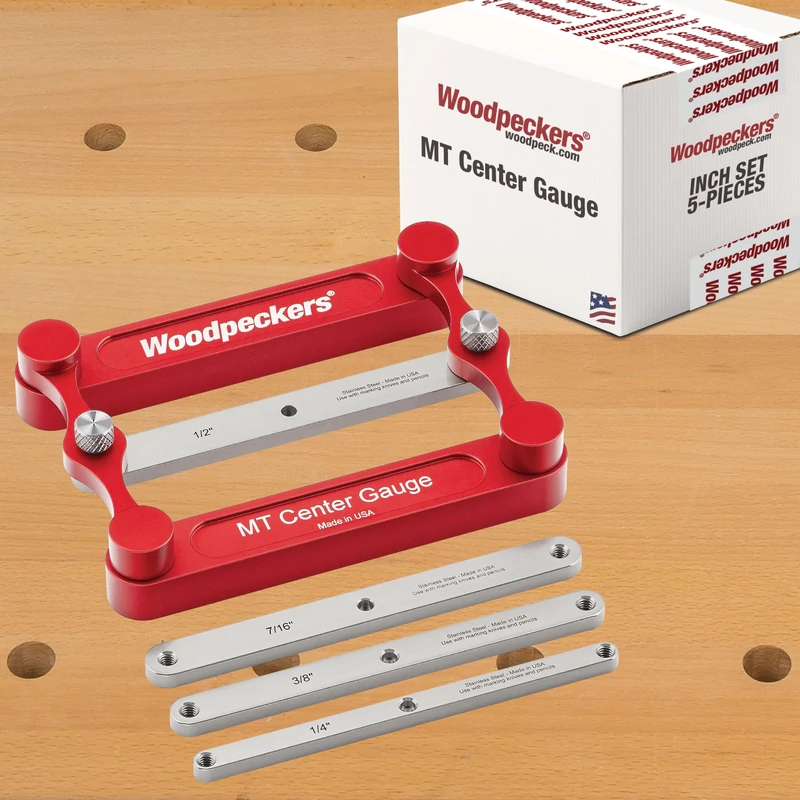
Choose the MT Center Gauge when you want the layout centered on the thickness of your stock. Its parallelogram arms close against the two sides and place the marking bar between them. You can use the bar’s center hole for a pencil centerline or score along both sides for joint boundaries.
This is the Inch Set, with four stainless-steel marking bars: 1/4, 3/8, 7/16 and 1/2 inch. Those figures are bar widths used to lay out the joint, not the thickness of the steel bars. Choose the width that matches your joint plan rather than assuming the tool selects it for you.
The arms accommodate stock up to 2 inches thick. Two thumb screws secure the interchangeable bar. The centering mechanism provides a different reference from an ordinary edge-offset gauge: it follows both sides of the stock rather than maintaining one fixed distance from a single edge.
The package contains one gauge and four imperial bars. The Deluxe kit is a different selection with additional metric bars. Compare the dual-blade Kebiki when you want independently chosen edge offsets, or the compact DFM square when a smaller square-and-center-finding tool better suits the work.
Choose for your actual work
- Choose a bar width against the intended joint width.
- Distinguish centered layout from an independently set edge offset.
Fit checks & limits
- Metric bars from the Deluxe kit are not included in this selected Inch Set.
- No guarantee of error-free layout regardless of stock condition or handling is made.
Questions before you choose
When is a centering tool more useful than an edge-offset gauge?
It is relevant when the joint must be centered between the two stock faces. An edge gauge is the alternative when you want to set the distance from one chosen face.
Do I get the metric marking bars?
This selection is the Inch Set with four imperial widths. The maker’s Deluxe selection includes additional metric bars and should not be confused with this package.
Are the bar sizes the steel thicknesses?
The maker identifies them as marking-bar widths. Marking both sides lays out that width; the figures are not a stated material-thickness specification.