
What this tool adds
What this tool adds to your bench
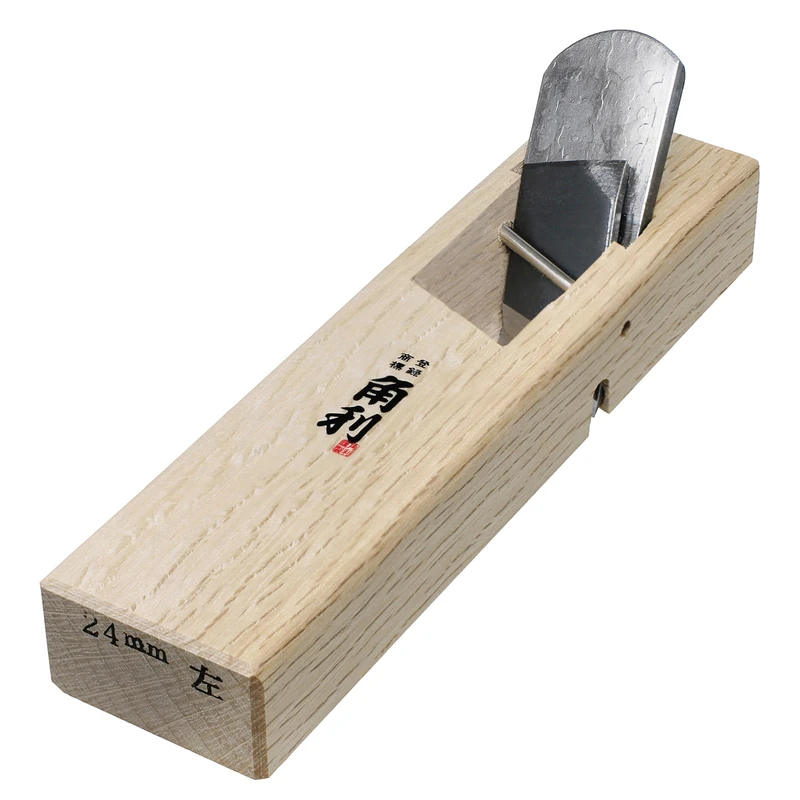
The useful feature here is the side of the joint the blade can reach. This selected 24 mmLeft plane is for finishing a rabbet or inside corner with its cutting edge placed at the working side of the wooden body. The listing describes positioning the tool to the left of the corner and shaving the right side. Choose that access arrangement against the actual joint, rather than selecting the word Left solely from your dominant hand.
The maker identifies 24 mm as both blade width and cutting width for this format. Its body footprint is 150 ×38 mm, matching the approximately 5.9 ×1.5-inch footprint described in the listing. That is a body measurement, not a claim that a 24 mm blade can enter every 24 mm opening or that the tool will fit a stopped corner with no room for its body.
The blade has a two-layer construction: Japanese high-carbon cutting steel laminated with soft iron, as described for the selected listing. Its body is Japanese white oak. The side-reaching inside-corner arrangement is distinct from the narrow18 mm grooving plane, whose body follows the groove, and from a broad-base router plane working a recess floor.
Choose this plane when the inside-corner contact and left-side arrangement answer your fitting problem. Compare the No. 91 shoulder plane for a narrow metal-bodied shoulder contact, or the Stanley 12-978 for fence-guided rabbet work with alternative cutter positions. The offer is one complete left-format plane with its blade; it does not establish a supplied right-format companion or a set of different widths.
Choose for your actual work
- Check which side of the body must register against the joint. TheLeftlabel describes the working arrangement, not a universal hand preference.
- Compare the blade reach and room for the body before ordering for a stopped corner. Body footprint and cutting width are different requirements.
Fit checks & limits
- Confirm height if choosing a fitted holder. The 5.9 × 5.9 × 5.9-inch listing entry does not give a reliable complete-tool footprint.
- The 24 mm figure describes cutting width, not maximum cutting depth.
- Check stopped-corner clearance and exact replacement-blade fit. This is the selected left-format plane; a right-format partner is not included.
Use & care
The listing describes whetstone sharpening for the laminated blade. Use the maker’s model guidance for blade preparation and adjustment; no fixed honing angle or hammer force is prescribed here.
Questions before you choose
DoesLeftmean only a left-handed person can use it?
The listing describes the tool’s position at the corner: placed to the left, shaving the right side. Choose by the joint contact and access needed, rather than a hand label alone.
Is 24 mm the maximum depth of the rabbet?
It is the stated blade and cutting width. A maximum working depth is not established by that dimension.
Why compare it with a shoulder plane?
Both can be relevant to fitting a joint wall, but they have different body and edge-contact arrangements. Compare the space and the surface to be trimmed; similar blade width alone is not enough.