
What this tool adds
What this tool adds to your bench
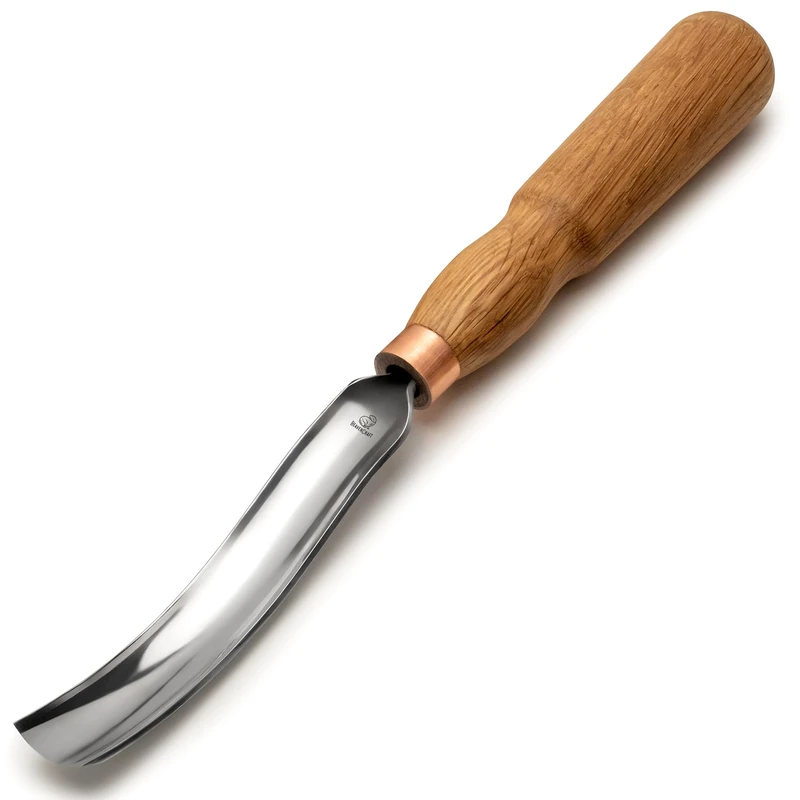
The G7L/22 provides a long-bent approach to spoon, bowl and relief-carving work. Its curve and longer blade arrangement give a different approach from a compact short-bent gouge. Choose it when that reach and the space around the handle suit the hollow or background you need to shape.
The selected cutting width is 22 mm with a No. 7 sweep. The blade and handle are listed at 125 mm and 150 mm respectively, also labelled in the supplied dimension graphic. Width, sweep and blade length describe different parts of the tool; none alone establishes a maximum hollow depth.
The selected listing and maker identify a 1066 high-carbon steel blade. Use it by hand: the maker explicitly describes work without a mallet. Its current notice recommends softwood even though broader text also mentions hardwood, so choose a designated mallet tool if denser stock removal is the priority.
Compare this long-bent form with the compact K8a/14 for different handle clearance, or with a straight compact gouge for another approach to a rounded cut. The handle is described simply as wood because its species differs across the sources. A fixed sharpening angle is also not adopted while the maker’s angle figures disagree.
Choose for your actual work
- Compare long-bent and compact short-bent approaches against room around the actual hollow.
- Choose working method before assuming a larger tool accepts a mallet.
Fit checks & limits
- No mallet use or maximum hollowing depth is established.
- Handle wood species and the exact bevel angle are unresolved.
- Hardwood performance is not promised despite broader source wording.
Use & care
Confirm the model’s current bevel instructions before using a fixed-angle sharpening setup.
Questions before you choose
Does full-size mean it is suitable for a mallet?
No. The maker specifically describes this model for work without a mallet. Compare an explicitly mallet-capable gouge if that is your intended method.
Why choose it instead of the compact short-bent gouge?
Compare the long-bent blade arrangement and reach with the space around the hollow. The two forms change the approach, not just the cutting width.
Can I set my sharpening jig to the listed angle?
The maker’s page contains different 20- and 25-degree figures. Confirm current model guidance before relying on one fixed setting.