
What this tool adds
What this tool adds to your bench
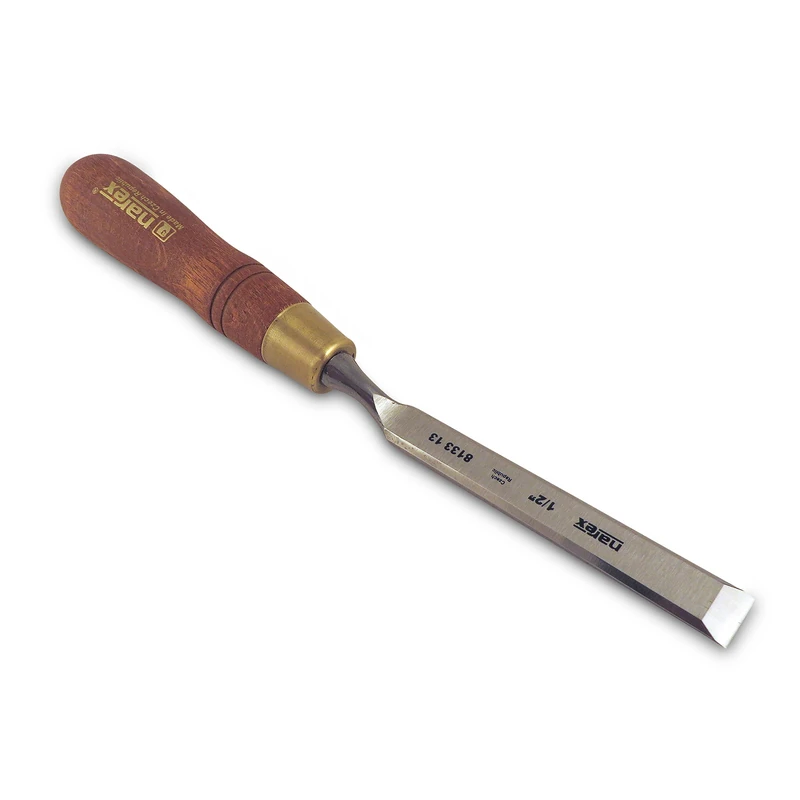
The bent neck is the reason to choose this chisel. When a straight handle gets in the way of trimming close to a flat surface, the offset arrangement provides a different approach to the cut. It is useful to compare that clearance against the actual joint rather than treating the bend as a general upgrade over every straight chisel.
The selected width is nominally 1/2 inch (13 mm). The listing describes a 30-degree neck bend and a 25-degree cutting bevel. Those angles concern different parts of the tool: one changes handle clearance, while the other describes the cutting edge. Neither figure specifies how deep a recess the tool can reach.
The blade is chrome-manganese steel at a stated 59 HRc, with a slimmer cross-section than the brand’s bench chisels described in the listing. The stained hornbeam handle has a brass ferrule. This combines a steel cutting blade with a reinforced wooden handle, not a brass blade.
Compare this model for flush trimming or finishing a place where the offset gives useful access. The long straight paring chisel is another option when reach along an open surface matters more. For forming a deep mortise from rough waste, compare the dedicated mortise set rather than choosing solely by a similar cutting width.
Choose for your actual work
- Check whether the raised handle actually solves the obstruction at your work surface.
- Keep neck angle, cutting bevel and available recess depth separate when comparing tools.
Fit checks & limits
- No maximum recess depth, exact reach or universal stopped-corner access is established.
- The listing’s structured model range covers several widths; this offer is one selected half-inch tool.
Questions before you choose
What does the 30-degree angle change?
It is the bend at the neck, which changes the handle’s position relative to the blade. The separately stated cutting bevel is 25 degrees.
Should I replace my straight paring chisel with it?
Choose by access. The offset can help near a surface; a long straight tool can suit an open approach. One shape does not make the other universally unnecessary.
Does its width tell me how deep it can trim?
No. Nominal cutting width and available reach are different measurements. A maximum recess depth is not established here.