
What this tool adds
What this tool adds to your bench
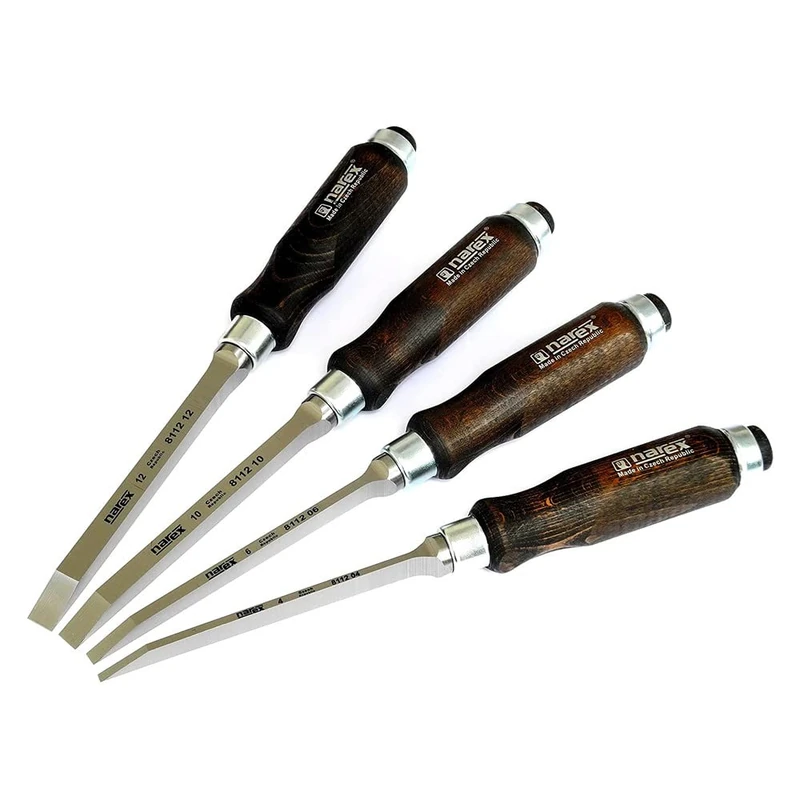
Choose this set for forming mortises: the recessed sockets that receive a tenon. Its four widths are 4, 6, 10 and 12 mm. That selection matters when laying out a joint because a blade must suit the intended slot; buying four widths does not provide every intermediate size.
The blades have side relief along both their height and length. This leaves clearance beside the blade as it works into the mortise, unlike choosing a tool solely for a wide, flat finishing face. It does not eliminate the need to remove waste progressively or guarantee that the tool cannot bind.
Narex specifies forged chrome-manganese steel at 59 HRc and oval beech handles with steel reinforcement. These are complete handled mortise chisels, rather than interchangeable cutters for a powered mortising machine. Their role is different from a long, slender paring chisel used to shave a joint to its final fit.
Select the set when several mortise widths are part of your work. For broad timber-frame waste removal, compare the separate 30 mm carpenter’s chisel; for delicate final fitting, compare the long paring model. The set contains one tool of each stated width, not multiple tools at the same size.
Choose for your actual work
- Match the actual blade width to your planned mortise before laying out the joint.
- Choose by the depth and type of waste removal, then compare finishing tools separately.
Fit checks & limits
- No powered mortiser compatibility is established; these are hand chisels.
- The available size field does not establish individual tool length. Maker weight includes packaging and is not used as net tool weight.
Questions before you choose
How should I choose a mortise width from this set?
Start with the joint drawing and the intended tenon. The available blades are 4, 6, 10 and 12 mm; an intermediate slot width is not supplied as an additional tool.
Why not use the long paring chisel for the same job?
The long paring tool is for controlled hand-pressure finishing. This set provides robust mortise profiles for removing waste inside a deeper socket.
Does the side taper prevent every jam?
It provides clearance beside the blade. Workpiece geometry, chip removal and technique still matter; a jam-free result is not guaranteed.