
What this tool adds
What this tool adds to your bench
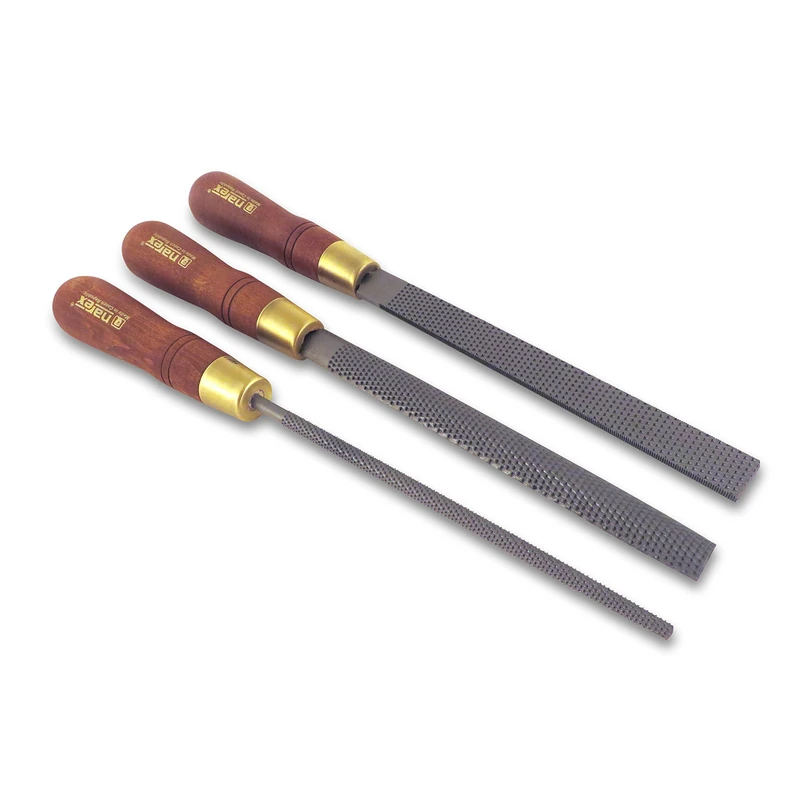
Choose this set when one flat rasp cannot follow all the shapes in your project. The three profiles are flat, round and half-round. Use their different contact shapes to compare a straight face, an opening or a concave curve rather than treating them as three copies of the same tool.
All three working blades are 200 mm long. The selected listing gives an 8 mm round size and 20 mm widths for the flat and half-round tools. Twenty millimeters is approximately 0.79 inch: compare those widths with the actual opening or curve, rather than expecting a one-inch-wide profile.
The selected description identifies a machine-stitched coarse pattern, with 16 cuts per square centimeter. Narex specifies tool steel hardened to 45 HRc and stained, waxed hornbeam handles. These are cut-density and material specifications, not a sandpaper-grit number or an independently measured removal rate.
The offer contains three complete handled rasps. Handles are listed at 145 mm and complete-tool lengths at 345 mm. Compare this set with an open-grid Shinto rasp when a broad lattice face is useful, or choose the solid profile that matches the curve. Nominal profile size alone does not guarantee entry into a close-fitting hole.
Choose for your actual work
- Match profile contact to a flat face, concave curve or opening.
- Compare cut density separately from abrasive-grit ratings.
Fit checks & limits
- No universal hole clearance or sandpaper-grit equivalence is established.
- Maker weight including packaging is not tool-only or per-rasp weight.
Questions before you choose
Which profile should I compare for a concave surface?
Compare the curved face of the half-round rasp with the actual curve. The flat and round tools provide other contacts; nominal dimensions do not guarantee a close fit.
Are these hand-stitched rasps?
The selected description specifies machine/CNC stitching. The stated uniform pattern is not presented as a hand-stitched construction or a tested finish-rate claim.
Does 16 cuts/cm² mean a particular sandpaper grit?
It is the tooth-cut density used for these coarse rasps. No direct sandpaper-grit equivalence is established.