
What this tool adds
What this tool adds to your bench
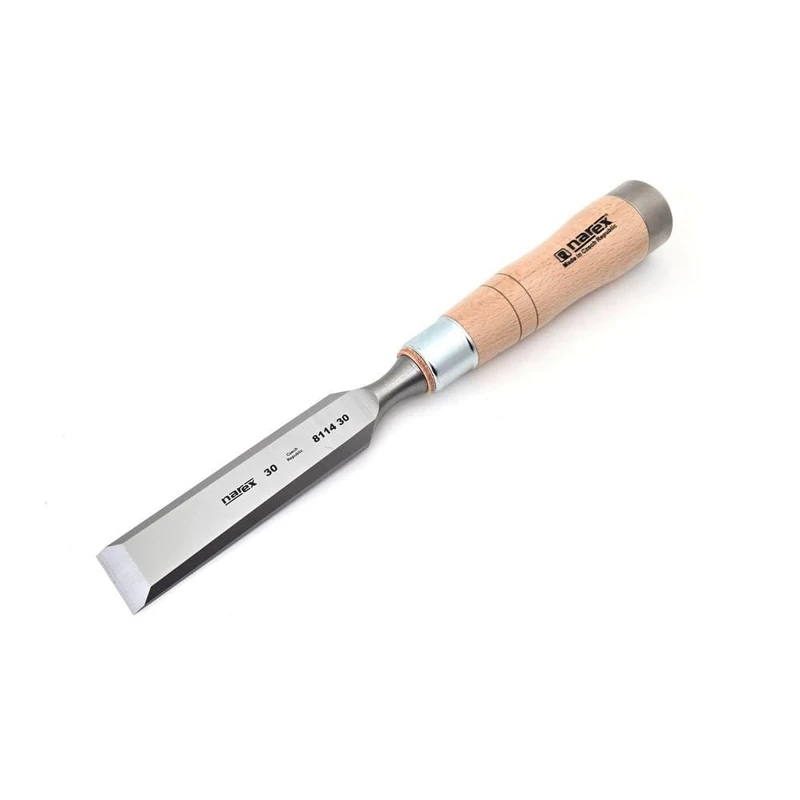
Choose this 30 mm carpenter’s chisel for rougher timber-frame work, such as forming notches, removing waste around tenons or cleaning a large mortise. Its broader, thicker blade serves a different stage of the job from a slender paring chisel used for the final small fitting cuts.
The selected listing describes a blade up to 3/8 inch thick at its thickest point. That is a maximum section, not a claim that the entire blade has uniform thickness. Compare the 30 mm edge with the space available: a robust tool is useful only if its cutting width and approach fit the joint.
The blade is chrome-manganese steel at a stated 59 HRc. The enlarged beech handle has a steel ferrule, leather washer and stainless steel end hoop. The source describes this construction for mallet work; it does not establish permission to substitute any metal hammer or to strike with unlimited force.
Select it when substantial waste removal is the missing function in your toolkit. Compare the narrower 4–12 mm mortise set for smaller sockets and the long paring chisel for hand-pressure finishing. Exact lengths differ between available source dimensions, so a close-clearance purchase needs confirmation rather than reliance on a single overall-length figure.
Choose for your actual work
- Check whether 30 mm fits the joint before choosing it for its robust construction.
- Use a separate finishing tool when the next task is removing small, controlled shavings.
Fit checks & limits
- Maximum thickness is not uniform blade thickness.
- Overall and blade lengths are not settled across the available listing and indexed maker figures.
- Mallet suitability is not a statement that every striking tool is permitted.
Questions before you choose
Would it be a useful first choice for a small mortise?
Check the 30 mm edge against the actual opening. The narrower mortise set may suit a smaller socket even though this tool is built for heavier work.
Is the whole blade 3/8 inch thick?
The listing states that thickness at the thickest point. It does not describe a uniform section along the entire blade.
Can it replace a long paring chisel?
They serve different working stages. This tool is described for heavier mallet-driven waste removal; the long paring tool is for finishing under hand pressure.