
What this tool adds
What this tool adds to your bench
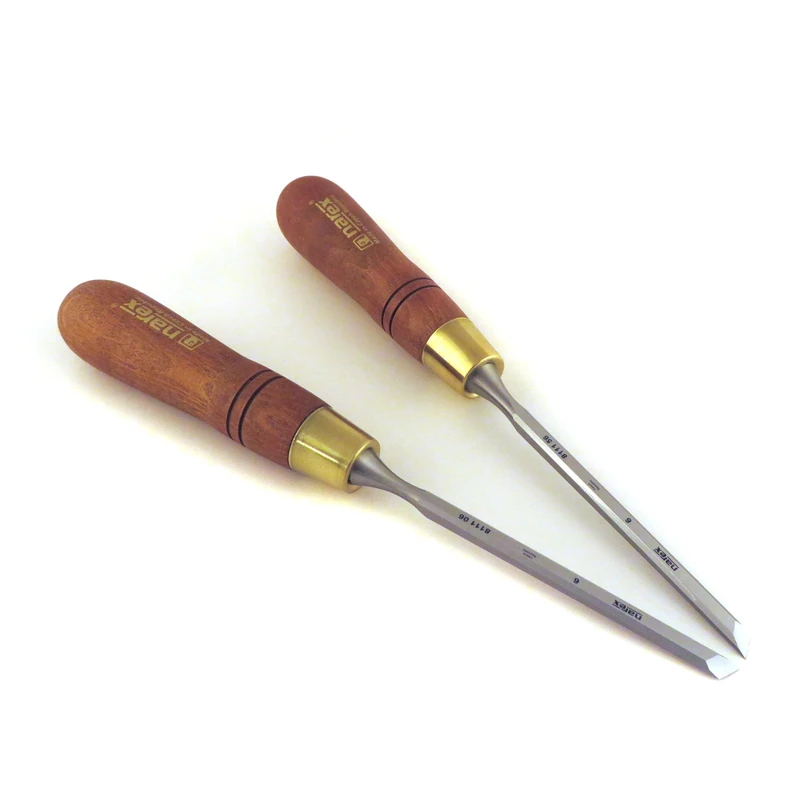
Choose the pair when an angled cutting edge helps reach beside a dovetail or trim a tenon shoulder. The left and right tools give opposite approaches to the joint. That is their useful difference from buying two identical straight chisels of the same width.
Each blade is nominally 6 mm wide, also marketed as 1/4 inch. The 30-degree skew describes the angled edge across the blade; the separate 25-degree bevel describes its sharpening geometry. The tool’s narrow width and handed point can help with access, but they do not guarantee clearance in every dovetail spacing.
The blades are chrome-manganese steel at a stated 59 HRc, with a slimmer cross-section described for this pair. Both have stained hornbeam handles and brass ferrules. Choose these for controlled trimming and corner access rather than expecting the robust profile of a deep-mortise chisel.
The selected offer includes the right and left tools with edge protectors. It explicitly has no retail packaging, so a wooden presentation box shown with another Narex bundle should not be expected. The listing also calls for sharpening before use: plan for initial edge preparation rather than assuming a ready-to-cut finish from the product photograph.
Choose for your actual work
- Compare the direction of the cutting edge with the side of the joint you need to reach.
- Allow for initial sharpening when deciding whether this pair fits your current workshop setup.
Fit checks & limits
- No wooden box is established for this unboxed offer.
- The nominal metric and imperial labels are not a measured guarantee of exact slot fit.
Use & care
The selected listing explicitly says sharpening is needed before use. Keep the supplied edge protectors for covered storage of the cutting edges.
Questions before you choose
When will I need both handed versions?
When access changes from one side of a shoulder or dovetail to the other. Opposite skew directions let you compare the approach without treating one tool as a reversible cutting edge.
Why are two different angles listed?
Thirty degrees is the skew across the edge; 25 degrees is the bevel. They describe different aspects of the cutting geometry.
Is it ready to use and supplied in a wooden box?
The listing calls for sharpening before use and specifies edge protectors without retail packaging. A wooden presentation box is not part of this selected offer.